Monday, 22 January 2018

Dry Skin and Fissures


A fissure is a crack or split in the skin and can be commonly found on the heel of the foot. These cracks can be a chronic problem and be very painful. They can also cause further problems for people with underlying medical conditions, for example, Diabetes or poor circulation.


Causes:


  • Dry Skin- Rough, flaky skin on the sole of the feet.

  • Moist Skin- Through excessive sweat, not drying feet properly, or wearing shoes without socks that don’t breathe well will all contribute to moist skin. This can cause breaks in the skin, leading the foot to become at risk of bacterial or fungal infections.

  • Walking barefoot- This leads to a reduction in the natural oils within the foot, therefore drying out the skin.

  • Long periods in the sun.

  • Cold Weather

  • Ageing- We lose the natural moisture within our skin as we get older.

  • Genetics

  • Diuretics- Taking water tablets

  • Decreased sweat

  • Backless shoes

  • Athletes foot

  • Various medical conditions- Venous Statis, Eczema, Diabetes, hypothyroidism, Downs, Kidney, Lymphoma, Malnutrition can all lead to dry skin and fissures.


Symptoms:


·         Cracked skin on heels


Treatment:


Heel fissures may go on their own if properly treated and moisturised. Cracks in the skin are at risk of infection so need to be properly looked at.


Self Care:


Check feet daily for signs of redness, swelling, or heat as these are common signs of infection.


Dry Skin:

·         Moisturise

·         Never walk barefoot

·         Avoid open shoes

·         Use a Foot file for callus


Moist Skin:

·         Ensure feet are dried properly

·         Do not apply cream between the toes

·         Wear cotton socks not nylon as cotton will help
          absorb any moisture

·         Use antifungal powders as appropriate


When to see a Podiatrist:


·         If the cracks become painful, or unmanageable


What can a Podiatrist do?:

·         Reduce hard skin

·         Dress affected areas

·         Suggest/ prescribe antifungals or antibiotics if  
          required

·         Footwear advice

·         Orthotic prescription

For more information see:

www.completepodiatry.co.uk

07434 727952
0161 477 4747

info@completepodiatry.co.uk

Corns and Callus


One of the most common reasons that patients attend clinic is due to painful corns or for callus removal. Corns and Callus are areas of thickened skin caused by excessive pressure or friction. They can cut anywhere on the foot, from the sole of the foot, in between toes, on top of the foot, or on the toes. Sometimes they can also be painful.

Callus-

An area of thickened and hard skin usually found on the soles of the feet.


Corns-

These are smaller areas of thick skin caused by pressure or friction. There are 5 types of corns:
1.     Hard corns (Heloma Durum)- These are the most common type of corn and typically can be found on the top of toe joints, on the end of toes, and on the sole of the feet. They usually appear due to deformity or excessive pressure. They are approximately the size of a small pea with an overlying layer of hard skin.
2.     Soft Corns (Heloma Molle)- These are caused due to pressure or friction, and are found between the toes. They appear white and are rubbery in texture due to moisture from sweat or inappropriate drying.
3.     Seed Corns (Heloma Mille)- These are tiny corns which can appear either singular or in clusters, and are usually more common in dry skin conditions.
4.     Vascular Corns- These can be hard or soft corns with blood vessels within them so tend to bleed very easily.
5.     Neurovascular Corns- These Corns are like vascular corns but also have nerve involvement. They tend to be very painful and are often inflammed.

Causes:


  •      Foot deformity for example, Bunion, or hammer toes
  • Poor fitting footwear
  • Abnormal foot function
  • Not wearing Socks
  • Dry Skin
  • Reduced Fatty padding


Symptoms:
  • Pain
  • Thick, rough area of skin

Treatment:

  • Self treatment by use of foot file or pumice stone
  • Apply foot cream daily
  • If problem persists see a Podiatrist who can:


o   Remove any hard skin or corns
o   Give Footwear advice
o   Address poor foot function
o   Relieve any excessive pressure


For further information see:

www.completepodiatry.co.uk

07434 727952
0161 477 4747

info@completepodiatry.co.uk


Tuesday, 27 June 2017

Accredited Practice


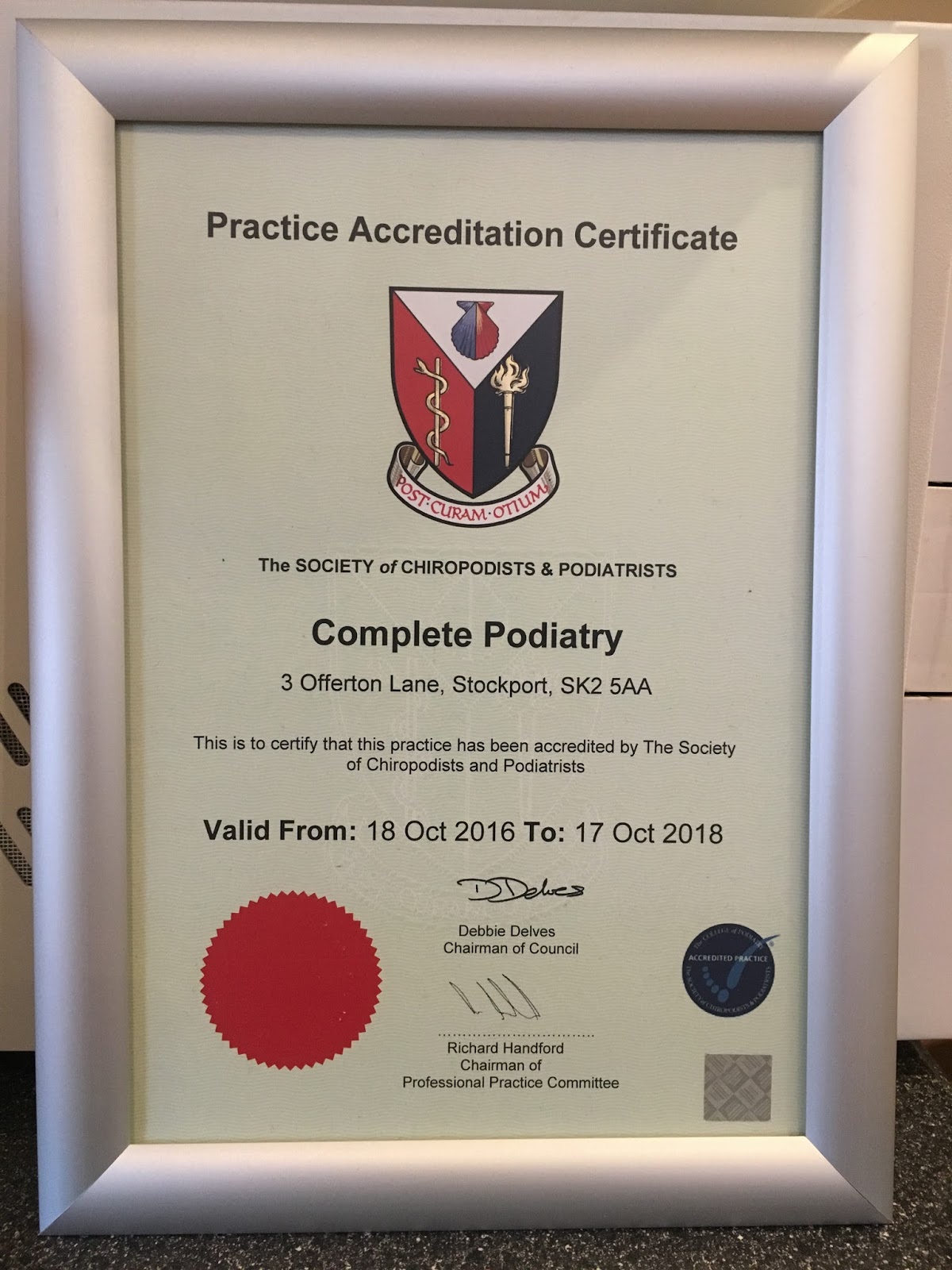
Did you know Complete Podiatry Practice is an Accredited Practice? But what does this mean?

For the practice to have been accredited by the Society of Chiropodists and Podiatrists we have reviewed our practice standards to ensure that they comply with national standards and best practice within the profession.

In achieving accredited status, we not only undertook a careful review of the practice, and asked another Podiatrist to check our findings, but we also agreed to the practice being inspected by independent assessors appointed by the Society of Chiropodists and Podiatrists.

The practice applied for practice accreditation because we feel that our clients have the right to be confident that their care is being provided within a safe environment. Not that the scheme is only concerned with the clinical environment, it also amongst other things ensures that:


  • Reusable instruments are properly cleaned and sterilized between patients
  • Staff engaged in continuing professional development so as to keep their knowledge and skills up to date
  • Patient confidentiality is respected and proper care is taken with patient information
  • We explain treatment options, where appropriate, and costs so that you can make an informed choice
  • Appropriate referral pathways exist for clients who need specialist care, and
  • Practice working methods are constantly reviewed.
I therefore feel confident in the care that you will receive within this practice.


Sunday, 23 April 2017

It's a Pods life!


Having just finished my mornings clinic, I was driving home in my car reflecting on the people I have just seen and questioning my role as a Podiatrist. I get asked numerous times a day (as most Podiatrists do) “How can you mess with people’s feet?” Or “Don’t you get bored looking at feet all day?” ……….

Well- after this morning’s clinic I can honestly say no- I never get bored, and ‘messing’ with feet all day is actually more varied than most people think! This morning’s clinic was nothing out of the ordinary for me but just summed up nicely the variety of skills we need as Podiatrists to journey through a clinic.

Its 8am and I arrive early this morning to catch up on making the orthotics I had promised a patient that was calling in later in the morning.  I open up and set my clinic up as usual. Start the steriliser so all my instruments are ready to go, and check the answerphone. I have a few patients to call wanting to book their routine check-ups. Added to my to do list (Don’t think they would appreciate a call this early on a Saturday!!)

My first patient arrives.  A new patient who was concerned with their feet due to blistering when walking. Yes, blisters were present and there was some callus (hard skin) as well. My main concern was assessing why the blisters were coming in the first place. A review of footwear and a gait analysis we discussed their walking style and offloaded the affected areas with a pair of orthotics. Footwear was also discussed and general foot care advice given to help prevent future problems. Patient left happy, and I felt great too knowing my day had started well.

Next came one of my regular patients who attends for nail care as they have mobility issues and struggle to do it themselves. It’s so rewarding being able to help. Such a simple treatment yet so important to keep people mobile and independent. Also, got a chance for a catch up on their recent holiday away with relatives. I love hearing the stories of places patients have been all over the world. The joy they have in telling me their stories, can make me almost imagine I have been there myself.


I sneak in a quick brew, then bring in my next patient. A nail surgery redressing from a patient who I had undertaken nail surgery on the previous day. I find the first dressing appointment important to see how the surgery had gone. Thankfully, all was ok and the surgery had gone well. Knowing that the patient managed a full night’s sleep for the first time in months as they were pain free is fantastic!


Then in walked one of my favourite patients (I know we shouldn't have favourites but hey, she brings chocolate and I’m easily bought!!) The chocolate biscuit goes down a treat as I continue with my treatments. She comes for her ‘usual’ as she calls it. It may seem to patients that we just cut nails, remove hard skin and give a general MOT, but we are also doing so much more. When holding the foot I’m checking pulses, ensuring sensation is intact, or that there are no significant changes to the feet since your last visit. Nails are cut to ensure comfort, and thickened nails reduced to offload pressure and prevent significant tissue breakdown under the nails. Corns and callus are removed to ensure pain free walking, leaving a feeling of walking on air (still one of my favourite phrases from patients).


 After a couple more of my regular patients, and a good gossip about everything from the weather (that we finally have some sun), through to football, and the best chippies in Offerton I welcome my patient collecting their orthotics. With a 3-day turnaround of casted orthotics the patient was looking forward to getting back out walking. Orthotics should always be fitted personally to ensure fit to shoe, and that the prescription is helping the areas it is designed to! Some stretches exercises later and orthotic wear advice, it’s time to wrap up my clinic for the day. After a catch-up of all patient messages and tidy up and cleaning of my instruments, it’s off home for an afternoon of what's left of the sunshine with my family.        


So, when asked do I get bored with feet- absolutely not (I don’t have time to be bored!) or how do I mess with people feet all day- I don’t. I look at the whole body, from the feet right up to the head to look at how you are stood, how you move and your overall alignment. I also need to be aware of any medical conditions and your medication to know how it can impact your feet. But, most importantly of all I listen to a patient’s needs, ensuring I build trust with each individual, so that we work together to develop a treatment plan to aid with their problems. I love my job, I love helping others but most of all I’m #ProudtobeaPod.


Wednesday, 29 June 2016

Flat Feet in Children


One of the most common reasons children are referred to a Podiatrist is due to flat feet.
Here I discuss the causes of flat feet and any treatments that can be provided.


Flat feet can be defined as a foot that has a low or absent arch when standing. The ankles also appear to be rolling inwards. This can occur in one or both feet.


What are the causes of Flat Feet?

Most children are born with flat feet, as their arch is yet to form. This should develop around the age of 3 to 4 years.


There are two types of flat foot, which are flexible and rigid.

Flexible Flat Feet

Nearly all children will have flexible flat feet. Generally flexible flat feet do not cause any problems and the arch will continue to develop as the child grows. No treatment is usually required unless there are specific symptoms for example:

  • Pain, tenderness or cramping in feet, legs or knees
  • Outward tilting of the heel
  • Awkwardness or changes in walking
  • Difficulty with shoes
  • Voluntary withdrawal from activities.

Rigid Flat Feet

Rarely, a flat foot can be rigid, caused by the bones in the foot. These bones can be joined together or badly aligned which restricts movement and can cause pain. X-rays maybe required to diagnose this problem.

Assessing my Childs foot type

In order to determine which foot type your child has a simple test can be carried out. Ask your child to stand on their tiptoes. If an arch appears then the condition is probably flexible, and if an arch does not appear they may have rigid flat feet.


What treatment is required?


Unless there are any symptoms then treatment is usually not required for flexible flat feet.
Children with rigid flat feet will usually require a supportive insole which fits into their shoe to reduce foot pain, which can be provided from your Podiatrist.

The use of insoles will not change the shape of a childs foot in the long term, they are designed to help support the foot by holding it in a better position during growth.


What to do if you are worried

If you do have any concerns or require further advice then consult your Podiatrist.
For more info:

Thursday, 23 June 2016

June is Feet For Life Month


Summer’s coming – time to let your feet shine


After months of being snuggled inside furry boots and cosseted in thick socks, it’s time to take a peek at your feet and give them a makeover for summer.

The College of Podiatry’s annual Feet for Life Month in June is the perfect time to give your tootsies some care for this season’s outing. Here’s our A-Z of looking after your feet:
Arch pain – flip-flops and flimsy sandals provide no/little arch support and constant wear can cause pain. Alternate your footwear so that this style of footwear isn't worn permanently.

Blisters – strike more often in hot weather. They’re caused by rubbing, especially between the toes if you’re wearing flip-flops with ‘thongs’. Prevent blisters by stretching out sandals. Wear them with socks and walk around indoors to loosen them up. Or use foot balm to protect your skin from chaffing. If you do get a blister, don’t pop it. Cover it in a plaster and if it bursts, apply some antiseptic.

Bunions - a condition where the big toe is angled excessively towards the second toe and a bony prominence develops on the side of the big toe. The condition is genetic and is not helped by wearing narrow shoes with pointed toes. Some treatments can ease the pain of bunions such as padding in the shoes, but only surgery can correct the defect. If you experience frequent pain, see a podiatrist.

Corns and calluses – occur as a result of pressure on the foot. Corns appear over a bony prominence such as a joint and a callus usually occurs on the sole of the foot. Do not cut corns yourself; especially if you are elderly or diabetic and do not use corn plasters or paints which can easily burn the healthy tissue around the corns. Commercially available cures should only be used following professional advice. Calluses can usually be kept at bay by using a pumice stone or non-metal foot file gently in the bath.

Diabetics - need to be especially careful in the summer. If a diabetic suffers from a condition called peripheral neuropathy, (numbness or tingling in their feet), cuts or injury to the skin are less likely to be felt e.g. by stepping on a thorn, piece of glass, splinter or other foreign body or from the shoes rubbing. Therefore, those living with diabetes must take extra care and do a daily foot check to make sure skin is intact and not broken. Try and avoid walking around barefoot. If you have a wound clean it and put a dressing on it and if it doesn’t appear to heal after 3-4 days get it checked.

Elegant – the average shoe size for women in the UK has increased from a size 4 to a size 6 since the 1970’si so if you have large feet, do not be tempted to buy a smaller size. Instead, choose an elegant style in a neutral colour

Fungal infection - such as athletes foot can lead to intense itching, cracked, blistered or peeling areas of the skin. If left untreated it can spread to the toenails causing thickening and yellowing of the nail. Fungal infections are highly contagious so avoid handling and do not use the same towel for your feet as the rest of your body. You can buy over the counter remedies but nail infections do not often respond to topical treatments so you may need oral medication. See a podiatrist if your infection persists.

Gout – a form of arthritis that can result in waking up in the middle of the night with an acute throbbing pain in the big toe, which is swollen. Usually only one of the big toes is affected. The pain lasts for around three or four hours and will then subside and usually not return for a few months. It can be controlled by drugs, which your GP will be able to prescribe. The application of ice or cooling lotions will help during an acute phase.

Heels - cracked heels are painful and occur where the skin has become dry or has experienced excessive pressure. They can be caused by wearing open-backed shoes such as sandals and flip flops which rub around the edge of the heel. To prevent them, moisturise regularly and use a pumice stone or non-metal file in the bath or shower. If the problem worsens see a podiatrist as some severe cases can require strapping of the cracks in order to allow the feet to heal.

Ingrown toenails - these pierce the flesh of the toe and can be extremely painful and lead to further infection. They most commonly affect the big toenail but can affect other toes too. To reduce risk use nail cutters and cut nails straight across and don’t cut too low at the edge or down the side. If you have an ingrowing toenail, see a podiatrist who can remove the offending spike of nail and cover with an antiseptic dressing. If you have bleeding or discharge, you may require antibiotics.

June – is Feet for Life month and you can find more information on foot health, with free leaflets and tips at The College of Podiatry’s website www.feetforlife.org.

Knock-on effect – don’t wait for signs of pain before seeking foot help as foot problems can have a knock-on effect on your mobility and general wellbeing.

Loving care – to fresh tired, aching feet, massage gently with a foot roller, or better still, ask you partner to massage your feet.

Minor cuts - or abrasions should be covered with a clean dry dressing.
 
Nail polish – nails need a break to breathe from time to time, so give your nails a break from nail polish about once a month for a few days to a week. This can help prevent discoloration—particularly if you like to use dark-colored nail polishes.

Odour – prevent excessive foot sweating and odour in the summer by wearing open sandals when you can, or change tights or socks at least once a day. Choose socks containing at least 70 per cent cotton or wool, although some man-made fibre socks are specifically designed to keep feet dry. Wash feet at least once a day and dry carefully between the toes. Wear alternate shoes daily to allow them to dry out. If odour persists try an antibacterial soap.

Paddling in the sea – then wear flip-flops or other lightweight shoes to avoid injury from sharp shells, sea creatures and broken glass.

Questions and queries - 90 per cent of women experience foot pain, but only 30 per cent have every sought professional helpwww.feetforlife.org. ii. Use the find a podiatrist search function at The College of Podiatry’s website

Rough, hard skin – do not cut this (it’s likely to grown back even harder). Use a pumice stone or file.

Sun cream – don’t stop at the ankle. Put sun cream on tops and soles of the feet. Lots of people neglect to apply a good SPF to their feet, but don't make this big mistake. Not only does the skin on your tootsies need protection, but nails are made of protein and are therefore as vulnerable as your skin.

Toe nails – a good time to give your toe nails a trim is after a bath when the toe nails are softer. Trim your toe nails regularly, using proper nail clippers. Cut straight across, not too short, and not down at the corners as this can lead to in-growing nails. File them, if that is easier.

UV light – the tops of bare feet (like the top of our heads and our shoulders) are at risk of the damaging effects of harmful UV sun rays, so remember to put lots of sun cream on the tops and soles of feet.

Verrucae – is a type of wart that looks like a small, dark puncture mark in the early stages but later turns grey or brown. It’s contagious through direct contact. You can buy over-the-counter remedies from your pharmacy; ask for products with salicylic acid. If at any stage
your verruca becomes painful and the surrounding skin goes red, stop treating immediately and see a podiatrist.  Warts – you are more likely to contract if you already suffer from germ-festering conditions like athlete's foot or hyperhidrosis, can be passed on through direct or indirect contact. A wart that develops on the foot is called a verrucae.

X – take Xtra care when wearing high heels because the unstable position can result in ankle sprains and prolonged wear may cause the calf muscle to become shortened over time. The body compensates for this tightness in the calf-muscle by lowering the arch of the foot, or affecting the knee, hip or back. So keep high heels for special occasions. Save backless high-heeled shoes for evening glamour. Backless shoes force your toes to claw as you walk, straining the muscles if worn over a long period.

Yellowing nails - the most common causes are fungal nail infections, nail psoriasis (see a podiatrist) or the frequent application of nail varnish.

Zzzz – if you are pregnant, your feet will be taking extra weight and strain so rest them by raising your feet and legs up whenever you can and do daily leg and calf stretches

More information on foot health, with free leaflets and tips can be found on The College of Podiatry’s website www.feetforlife.org.

Monday, 16 May 2016

May is Keep Walking Month


May is Keep on walking month and to help support this worthy campaign here is afew tips on the benefits of walking and how to take care of your feet from the Society of Chiropodists and Podiatrists.

Benefits of walking

Walking is good for you and if done at a brisk pace for regular exercise it helps condition your body and improve overall cardiovascular health in the same way running and jogging do. But compared with running, walking carries a significantly lower risk of injury, it reduces stress and gives you time to clear your head and aids better sleep. It’s the nearest thing to ‘perfect’ exercise in terms of a safe, all-round workout and it doesn’t cost a penny or need any special equipment.
  • If you walk an extra 20 minutes a day, you’ll burn off more than 3kg of body fat a year
  • A single step uses up to 200 muscles. So you’re not only doing a little cardio, but toning your muscles too and walking is easy on your joints
  • Walking can halve your risk of coronary heart disease and help prevent some cancers and cuts cholesterol
  • Walking may slow cognitive decline in adults, especially those with existing conditions such as Alzheimer’s
  • Walking can help to prevent the onset of type 2 diabetes
  • Walking requires little equipment can be done almost anywhere and is entirely free.
  • Can help improve circulation in your feet by stimulating the development of tiny new blood vessels.
What walking does to your feet?In an average lifetime, we walk about 100,000 miles, which is tough on our feet. Yet our bodies were designed for moving not standing still, so walking is good exercise. Walking helps the muscles and ligaments in our feet to work more efficiently, and helps keep them supple and flexible.

So even if you have to sit around a lot in your job or at home, try to get up and walk briskly for at least 30 minutes every day. Feet are adaptable and can withstand a lot of pressure before they rebel. If you walk a lot, it’s important to wear the right footwear which won’t damage your feet.

Foot Problems associated with walking
How a podiatrist can help you keep walking

Consult your podiatrist if you start to develop pain when walking, or consider a visit before embarking on your new walking programme.

The main role of the podiatrist is to help you maintain normal mobility and function in the feet and lower limbs. Podiatrists provide the basis for the ideal walking style and posture and identify any  conditions that may require further referral and management. They also relieve pain, treat infections and skin, nail, soft tissue and connective tissue problems. This is achieved in conjunction with other members of a multi-disciplinary health care team. Podiatrists can also give expert advice on footwear, so it is a good idea to take your walking  shoes with you when you go to  see your podiatrist.


For more information visit:
http://www.scpod.org/foot-health/keep-on-walking/